PHOTOCHEMICAL DEGRADATION PATHWAYS OF LINEAR LOW DENSITY POLYETHYLENE REVEALED BY INTEGRATED FTIR, RAMAN, AND AI-ASSISTED SEM ANALYSIS
Abstract
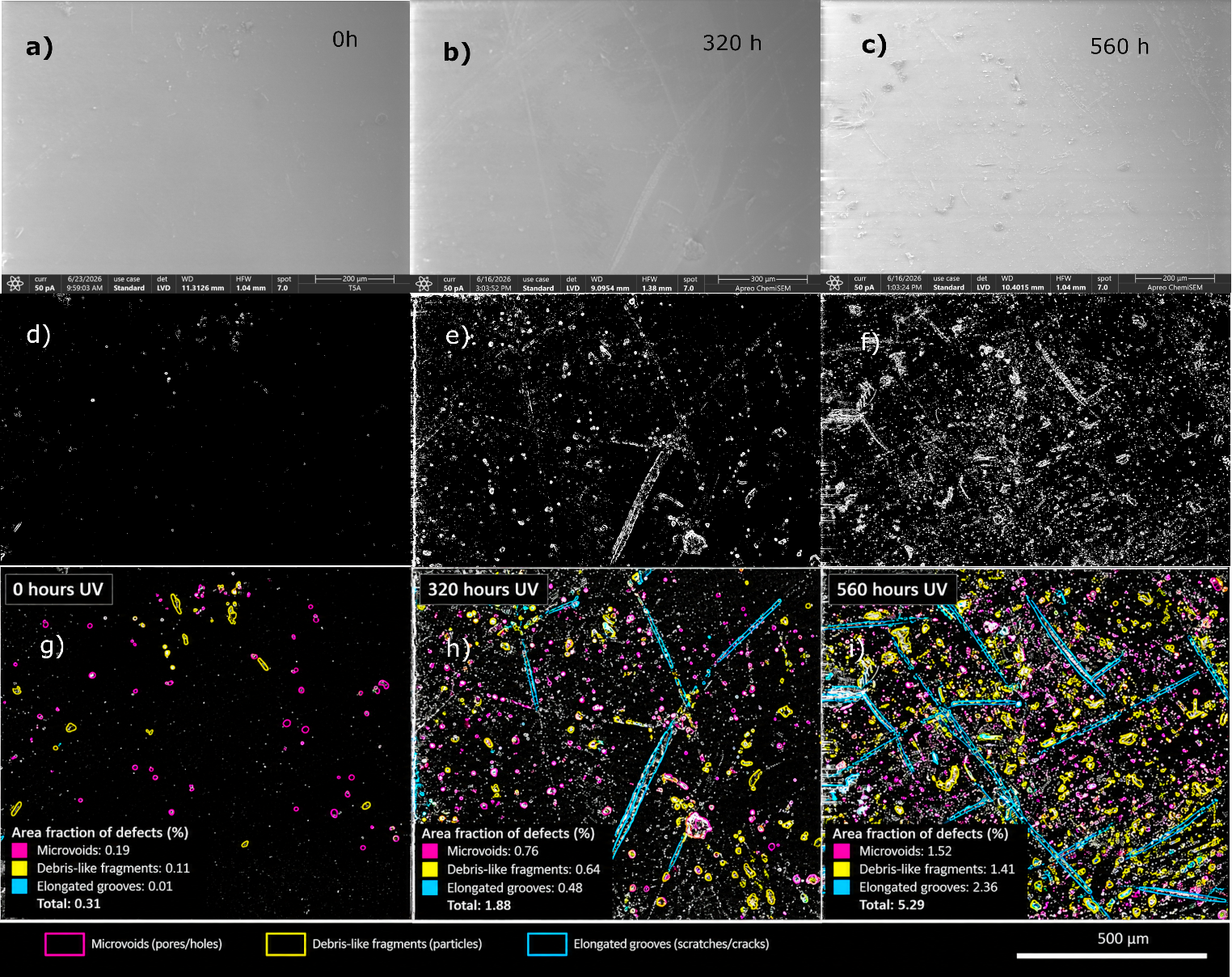 Linear low-density polyethylene (LLDPE) is the dominant polymer in agricultural films, mulch covers, and packaging throughout Ecuador and Latin America, where intensive agricultural economies drive high per-capita consumption. Its prolonged outdoor use under intense equatorial UV radiation accelerates photooxidative degradation, generating microplastic particles that have been detected in remote ecosystems including the Antarctic region, underscoring the global reach of local plastic degradation. LLDPE films were subjected to two parallel exposure regimes: (i) natural weathering on the rooftop of Yachay Tech University, Urcuquí, Ecuador, for up to 342 days, and (ii) accelerated UV irradiation in a laboratory chamber equipped with a 50 W LED source at 365 nm for up to 579 hours (~97 equivalent days, based on 6 active sunlight hours per day). Chemical and structural evolution was monitored by ATR-FTIR spectroscopy, Raman spectroscopy, and scanning electron microscopy (SEM). Carbonyl index (CI = A₁₇₁₅/A₁₄₆₃), crystallinity ratio (I₇₂₉/I₇₃₀), and Raman-derived conformational indices were calculated. AI-assisted image analysis was applied to SEM micrographs to quantify surface defect area fraction. Spectroscopic identification was supported by a polymer reference library of 18 pellet standards created in collaboration with the IAEA Marine Environment Laboratory, Monaco. Environmental weathering produced a carbonyl index of ~0.22 after 342 days, with strong linear kinetics (R² = 0.992), whereas 400 h (~67 equivalent days) of controlled UV irradiation yielded a maximum CI of ~0.08 (R² = 0.859). The crystallinity-related I₇₂₉/I₇3₀ ratio declined from ~1.70 to ~1.45, consistent with progressive disruption of crystalline domains. Raman spectroscopy confirmed conformational reorganization toward trans conformers and orthorhombic ordering. AI-assisted SEM analysis quantified defect area fractions increasing from 0.32% to 3.37% under ambient weathering and from 0.31% to 5.29% under UV irradiation. LLDPE photodegradation is a coupled oxidation–reorganization process involving carbonyl accumulation, chemi-crystallization, and progressive surface embrittlement that ultimately generates microplastic particles. Integrated ATR-FTIR, Raman, and AI-assisted SEM analysis provides a comprehensive multi-scale framework for predicting polymer service lifetimes and informing mitigation strategies.